
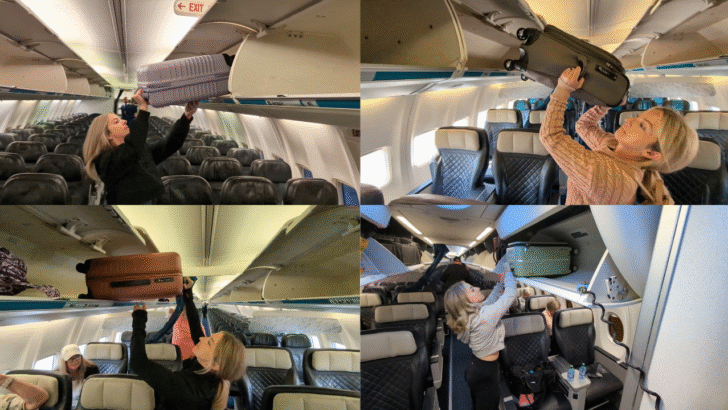
If you’ve ever stood at the gate wondering whether your carry-on will actually make it onboard (even though you know it's within the airline's dimensions), you’re not alone.
The truth is, it has less to do with your suitcase dimensions and more to do with a few behind-the-scenes factors airlines don’t always tell you about.
Key Takeaways
- It’s not just your suitcase dimensions that matter — four main factors decide if your carry-on makes it onboard.
- The aircraft type, the crew, when you board, and your ticket type can all make or break your chances.
- Even rule-abiding bags get gate-checked on smaller planes or full flights — planning ahead helps you avoid that stress.
- A few smart upgrades (or the right travel tools) can guarantee a smoother, faster boarding experience.
This post contains affiliate links, meaning if you click through and make a purchase I may make a small commission. I only share information about things I know, love and trust!
🧳 My Obsession with the “Perfect” Carry-On

I’ll admit it — I have a bit of an obsession with finding the perfect carry-on bag.
It’s partly because so many people are now trying to fly carry-on only — and yet, there’s zero consistency across airlines or even airports.
What luggage brands say their bags measure isn’t always what they actually are.
And what airlines claim they allow onboard can vary wildly — even between flights on the same route.
So one of the questions I get asked most often is:
“Will my bag fit?”
I get comments, DMs, and emails about this every single day.
And while I’ve built a growing database of which bags fit on which airlines, it’s not humanly possible to test every bag on every plane.
Because the truth is, whether your carry-on gets onboard comes down to four key factors — and it’s about more than just dimensions.
Let’s break them down.
✈️ 1. The Aircraft Type

The first thing that determines if your carry-on actually makes it onboard is… the plane itself.
Not all aircraft are built the same.
Some planes have overhead bins that could fit a small car. Others can barely handle a winter jacket.
The two most common aircraft types you’ll probably fly are:
- Airbus A320 family
- Boeing 737 family
These two dominate short- and medium-haul routes globally — with tens of thousands flying every single day.
But even within those families, bin sizes can differ dramatically.
- The Boeing 737-800 has spacious “Sky Interior” bins that can fit carry-ons wheels-first, like books on a shelf.
- Older 737s or smaller Airbus A319s, on the other hand, might require you to turn your bag sideways — or not fit at all.
And if you’re flying on a regional jet (like a CRJ, Embraer E175, or Dash 8), space gets really tight.
Even carry-ons that technically meet the size limits often get gate-checked on these smaller planes.

✅ Before you pack:
- Check your aircraft type on your booking page or boarding pass (look for codes like “A320,” “737,” or “CRJ900”).
- If it’s a small jet, plan ahead — keep your valuables, tech, and meds in your personal item so you can easily pull them out if your bag needs to be checked.
🧳 Bags I’ve personally tested that fit (even on regional jets):
And if you’re on a larger wide-body aircraft, like an A350 or 787, those bins are massive — you can usually stack bags sideways like books and still have room to spare.
👩✈️ 2. The Crew

The second factor? The crew.
Specifically, the ticketing agents and gate agents — the humans enforcing the rules.
And they don’t all enforce them the same way.
Some will happily wave you through with a smile. Others will make you drop your bag in the sizer even if it clearly fits.
They see hundreds of bags a day, and many can eyeball luggage with the precision of a tailor.
But once in a while, you’ll get the “we’re checking everything today” kind of agent — usually when the flight’s full or running behind schedule.
It’s not personal. They’re just trying to get hundreds of people and hundreds of bags through one narrow aisle before takeoff.

When travelers stick to carry-on limits, everything moves smoother:
- Flights leave on time.
- Crews stay on schedule.
- And theoretically, fewer delays = fewer extra costs.
But lately, travelers have been getting a little… carried away with their carry-ons.
That’s what causes gate chaos — crews end up playing Tetris with backpacks, coats, pillows, and souvenir bags.
When boarding drags out, other planes can’t pull into the gate, ground crews have to wait, and flight attendants stay longer — all of which costs airlines money.
And guess where that cost ends up? Right on your ticket, in the form of higher fares or bag fees.
✅ The takeaway:
Choose a carry-on that actually fits.
Something tried, tested, and trusted — like Travelpro, which is one of the most-used brands in the airline industry.
Gate agents know those bags fit, and it makes everyone’s life easier (yours included).
👜 3. How Early You Board
The third thing that decides if your carry-on makes it onboard? When you board.
You could have the most rule-abiding bag in the world — but if you’re one of the last passengers on, the bins are already full of coats, backpacks, and random duty-free bags.
Even though I wish there was a better system, bin space is first come, first served.
And once it’s gone, flight attendants start checking bags.
Your boarding group number is basically your bag’s survival ranking.
You’ll see it printed on your boarding pass (as “Zone 1,” “Group 3,” etc.).
Airlines assign these automatically based on your ticket type, elite status, or credit card perks.
If you’re flying with status or in business class, congrats — you’re in an early group.
My Best Business Class Flight Hack

And speaking of business class…
I actually got to experience it for the first time this year, thanks to a deal I found through Daily Drop Pro.
I saved over $4,000 for my husband and myself to fly to Europe — something I never thought I’d be able to afford.
It was such a special experience, and I’m still so grateful we got to do it.
Daily Drop Pro has both a free and a paid membership.
It’s not sponsored — I pay for the Pro version myself every year — but even the free version is worth signing up for if you love finding flight deals.
(Pro tip: they usually run sales on the paid version once or twice a year.)
👉 Sign up for Daily Drop here!
✅ Tips to Board Earlier (Even in Economy):
- Earn airline status — even the lowest tiers usually board sooner.
- Use an airline credit card — many include priority boarding perks.
- Book a higher fare class or bundle — sometimes just $30–$50 more gets you on earlier.
- Stay alert at the gate — sometimes groups are called out of order.
- Travel with someone in an early group? You can often board together.
If you’re in Groups 6, 7, or (yikes) 8 or 9 — your odds drop fast. At that point, every inch of bin space is spoken for.
And that leads us straight to the last — and arguably most overlooked — factor:
🎟️ 4. Your Ticket Type

At the end of the day, your ticket type determines your boarding group — and therefore, your carry-on’s fate.
Airlines have quietly turned carry-on access into a paid perk.
If you’re in business class, premium economy, or a bundled fare, you’ll board early, find open bins, and sometimes even get two carry-ons plus checked bags.
But if you’re flying Basic Economy or a “Light” fare — things get tricky.
Many of these tickets now exclude overhead bin access entirely.
Here’s how it breaks down:
- United, JetBlue, WestJet → Basic Economy = personal item only
- Ryanair, EasyJet → Overhead access only if you pay for “Priority” or “Plus”
- Air Canada, Lufthansa → “Economy Light” technically allows one carry-on, but you board late when bins are full
I’ve seen it firsthand.
When I flew Air France, my bag fit perfectly in their sizer, but the agent still warned me that if I boarded in Group 4–6, it might get checked because the bins could fill up.
Luckily, I made it on with plenty of space — but that moment taught me not to assume.
✅ Before You Book:
- Always read the fare details, not just the price.
Look for phrases like “personal item only” or “no overhead access.” - Upgrade strategically. Paying a little more for regular economy can save you surprise fees and stress.
- Compare bundle vs. add-on pricing. Sometimes bundles cost more than adding things individually.
- Book directly with the airline. Aggregator sites (like Google Flights) often hide carry-on restrictions until checkout.
- Use airline cards or loyalty programs. Even basic members often board earlier.
Because while your aircraft, crew, and timing all play a role… your ticket type often decides whether your bag rides above your head — or takes its own vacation in the cargo hold.
💬 Final Thoughts
At the end of the day, we’re all just trying to make it onboard with our bags and our dignity intact.
Do you think carry-on rules have gotten stricter — or are travelers pushing it more? Let me know your take in the comments below.
